Otolaryngologist, writer, athlete, politician, and a former member of the New York Celtic Medical Society
Dr. Oliver St. John Gogarty spent the last years of his life as a New Yorker, living at 45 East 61 Street, between Park and Madison. New York was his place of exile, where he focused on his literary career and frequented the bars on Third Avenue, eventually dying of a heart attack at Beth Israel Hospital on 22 September 1957 at the age of 79.
How Oliver St. John (pronounced ‘Sin Gin’) Gogarty ended up in New York is the end of a long path through some of the most pivotal events in Irish politics and literature in the 20th Century. The Gogarty family was unusual among Irish Catholics for having multiple generations of practicing
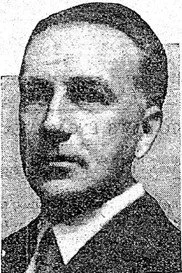
physicians, and was wealthy enough to send By Unknown author - The Irish Times, young Oliver to a series of Jesuit boarding schools Public Domain, in Ireland and the UK after his father’s untimely death from appendicitis at age 53.
His final boarding school was Clongowes Wood College in County Kildare, following which he entered the Royal University of Dublin (now University College Dublin), where he was so distracted by sports, drinking and writing poetry that he failed his first year examinations, although he did manage to win the University Gold Medal for English Verse along the way. His mother, who was very devout, had planned for Oliver to continue his medical studies at the Catholic University School of Medicine in Cecilia Street, Dublin, but found the registrar Dr. Bermingham rude, continuing to write as he held out a leaflet while saying “Here’s a pamphlet in which you will find the answers to all your questions”. If he had looked up, he would have seen mother and son heading for the door, out of Cecilia Street, and up Dame Street, to be enrolled in the ‘Protestant’ Dublin University (now Trinity College Dublin), where Gogarty’s late father had also studied medicine.
At Trinity he was said to excel at everything except medicine. He became the protegé of Reverend John Pentland Mahaffy and Professor Robert Yelverton Tyrrell, who encouraged him to pursue his literary endeavours. His course through medical school was meandering at best, eventually graduating in 1904 after 8 years of distractions, which included athletics – he was accomplished enough a footballer that he played semi-professionally for Preston North End Reserves while a schoolboy at Stonyhurst, in Lancashire, and for Bohemians in Dublin while a medical student. Despite Trinity preferring its students to focus on cricket and rowing, Gogarty pursued the uncouth and dangerous sport of road cycling, becoming the Irish 20 mile champion and only giving it up after having been banned for swearing.
The year before graduation he married Martha Duane from Moyard in Connemara, in the West of County Galway. Upon graduation, he followed in the footsteps of Sir William Wilde, father of Oscar and Ireland’s first otolaryngologist, by training in Vienna as an ENT surgeon under Ottokar Chiari and Robert Barany. He returned to establish his practice in Dublin in 1908, initially in the Richmond Hospital, but by 1911 had moved to the Meath Hospital, where surgeons operated together in one large theatre, giving the garrulous Gogarty a constant audience, and allowing him to fire freshly-extracted tonsils at his fellow surgeons. He would charge up to 100 guineas per operation to those who could afford it, and would operate for free for those who could not.
Irish independence was in the air at this time. Gogarty was friends from his Trinity days with Arthur Griffith, the leader of the United Irishmen and founder of Sinn Féin, and wrote pieces for the party’s publication The United Irishman. He would operate on wounded IRA volunteers and was instrumental in the 1920 escape from Mountjoy prison of Linda Kearns, who had been arrested for smuggling arms. He drove the getaway car, his less than discreet mustardcoloured Rolls Royce.
During the subsequent Civil War, Gogarty had to embalm the bodies of two of his heroes, Arthur Griffith and Michael Collins, whose deaths occurred within 10 days of each other. He was elected to the Seanad (senate) of the new Irish government, where he became a target for the anti-treaty IRA. In 1923, two events occurred: his home in Renvyle, Connemara was burnt to the ground, and he was kidnapped by de Valera’s Republican forces. He was taken to a boat house in Chapelizod on the banks of the River Liffey to await execution. He asked to be allowed to go outside to relieve himself, putting his coat around his shoulders. He was able to throw the coat over his kidnappers and plunge into the water, evading their bullets and using his swimming prowess to escape to safety. A year later, fulfilling the promise he made to the Goddess of the Liffey while swimming in her freezing waters, he released two swans into the river in the company of his wife, President WT Cosgrave, and his friend WB Yeats.
Gogarty had the distinction of winning a bronze medal in the 1924 Paris Olympic games, for literature, which was one of the arts competitions in the Olympics until 1948. He subsequently began to face numerous setbacks in his life. Already having lost a considerable amount of savings in the financial crisis of 1929, he was financially ruined by a lawsuit taken against him by Henry Sinclair, an uncle of Samuel Beckett, who claimed that he had been libeled in Gogarty’s successful memoir As I Was Going Down Sackville Street. With the political success of de Valera, whose appearance Gogarty described as ‘a cross between a corpse and a cormorant’, the Seanad was abolished in 1936, ending Gogarty’s political career. A qualified aviator, with the outbreak of World War II he tried to enlist in the Royal Air Force as a pilot or the Royal Army Medical Corps as a doctor but was rejected for being too old. He decided to move to New York in 1939, unaccompanied by his wife Martha, who had ‘an aversion to America and central heating’. In the US, Gogarty focused on writing and lecturing, and was recruited to join the New York Celtic Medical Society as a member. He had decided to move back to Ireland when he collapsed on the street one day in 1957 and died of a heart attack.
His body was flown back to Ireland. His family, unfamiliar with the amount of cosmetics applied by American morticians, was shocked by the appearance of the corpse, one of his sons exclaiming "That's not father, that’s Micheál Mac Liammóir". He is buried in Moyard in his beloved Connemara.
To avoid the distraction, it is left for last that his friend in Trinity, James Joyce, used Gogarty as the model for several of the leading characters in his books. Their relationship was fractious, but how their lives remained intertwined is revealed by Gogarty’s biography of St. Patrick being on his nightstand when Joyce died in Zurich in 1941, and Gogarty’s immortality as the inspiration for “Stately, plump Buck Mulligan” of Joyce’s Ulysses.